
Pick the ASUS for a 27-inch screen with a stated 300Hz refresh rate and the lowest stated response time here, the ArcticPro for a 27-inch IPS screen with wide stated color coverage, the SANSUI for a smaller 24.5-inch screen with four video ports, the ZZA for a 32-inch curved screen, and the Samsung for a height adjustable stand. All five listings state a 2560 by 1440 resolution, so the choice is screen size, refresh rate, panel type, response time, and stand or port details rather than resolution alone.
A 24.5-inch monitor and a 32-inch monitor sit differently on the same desk at the same resolution. Stated response times run from 0.3ms to 1ms, and only some listings state brightness, speakers, or a height adjustment.
As an Amazon Associate, we earn from qualifying purchases.



Pick by Your Need
- Best overall: ASUS TUF Gaming VG27AQM5A. It pairs 300Hz with a stated 0.3ms minimum response time at 27 inches.
- Best for wide color at 27 inches: ArcticPro 27 Inch Gaming Monitor. It states sRGB and NTSC coverage on an IPS panel.
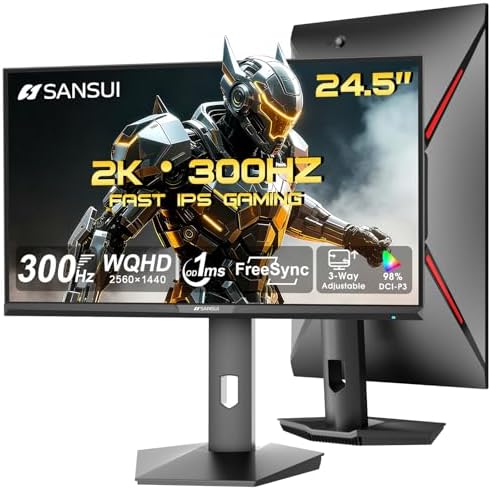
- Best compact pick: SANSUI 24.5 Inch Gaming Monitor. It is the smallest screen here and states four video ports.
- Best large screen: ZZA 32 Inch Curved Gaming Monitor. It is the only 32-inch, only curved model here.
- Best for a height-adjustable stand: Samsung Odyssey G5. It states a height adjustable stand.
Quick Answer
For most buyers, compare the ASUS and the ArcticPro first at 27 inches: one states 300Hz and a 0.3ms minimum response time, the other IPS color coverage and Adaptive Sync. Choose the Samsung for a height adjustable stand and HDR10, and the SANSUI or ZZA for a smaller or larger screen.
Comparison Table
| Product | Best for | Key stated figure | Trade-off | Buy |
|---|---|---|---|---|
| ASUS TUF Gaming VG27AQM5A | 27-inch play at 300Hz | 27 inches, 2560 by 1440, 300Hz | No stated brightness figure | View on Amazon |
| Samsung Odyssey G5 | Height adjustment and HDR10 | 27 inches, 2560 by 1440, 180Hz | Lowest stated refresh rate here | View on Amazon |
| ArcticPro 27 Inch Gaming Monitor | Wide color at 27 inches | The ArcticPro listing states both 340Hz and 300Hz as its refresh rate, so that figure is not settled. | No stated port counts | View on Amazon |
| SANSUI 24.5 Inch Gaming Monitor | Smaller desk footprint | The SANSUI listing states both 300Hz and 240Hz as its refresh rate, so that figure is not settled. | No built-in speakers stated | View on Amazon |
| ZZA 32 Inch Curved Gaming Monitor | Large curved screen | 32 inches, 2560 by 1440, 300Hz | Heaviest stated weight at 13.2 pounds | View on Amazon |
Decision Guide
Start with screen size and the stated dimension fields, read the same way for all five. The SANSUI states the smallest screen, 24.5 inches, with a width of 8.66 inches, a height of 21.02 inches, and a length of 21.93 inches. The 27-inch models state widths of 24.2 inches (ASUS), 24.34 inches (Samsung), and 2.68 inches (ArcticPro, length 24.17 inches, height 14.27 inches). The ZZA states the largest screen, 32 inches, with a width of 27.98 inches. Compare each finalist’s full stated dimensions against your desk.
Next, refresh rate. The ArcticPro listing states both 340Hz and 300Hz as its refresh rate, so that figure is not settled. The SANSUI listing states both 300Hz and 240Hz as its refresh rate, so that figure is not settled. The other three state one figure each: 300Hz for the ASUS, 300Hz for the ZZA, and 180Hz for the Samsung, the lowest single stated figure here.
Then look at response time as stated. The ASUS states 0.3ms GTG as a minimum, and the ZZA states 1ms GTG. The ArcticPro states 1ms as MPRT, and the SANSUI states 1ms as OD/MPRT. The Samsung states 1ms without that qualifier, so compare the figures as stated rather than as one identical test result.
After that, check panel type and sync. The ASUS, ArcticPro, and SANSUI state IPS or Fast IPS panels, the ZZA a VA panel with 1500R curvature, and the Samsung no panel type. For sync, the Samsung states AMD FreeSync, the ZZA AMD FreeSync Premium, the SANSUI FreeSync technology, the ASUS G-SYNC and ELMB Sync, and the ArcticPro Adaptive Sync.
Finally, check desk details. The Samsung states a height adjustable stand, the SANSUI pivot, swivel, height, and tilt ranges, and the ZZA an adjustable stand without ranges; the ASUS and ArcticPro state no stand ranges. Stated weights run from 10.1 pounds (ASUS) to 13.2 pounds (ZZA); the SANSUI states no weight. Check the product page for current details before ordering.
1. ASUS TUF Gaming VG27AQM5A — Best overall
This 27-inch ASUS states a 2560 by 1440 resolution, a 300Hz refresh rate, and a 0.3ms GTG minimum response time, the lowest stated response figure among the five. Its listing states Fast IPS technology, ELMB Sync, built-in speakers, Shadow Boost, DCI-P3 coverage, and DisplayWidget Center for settings changes with a mouse. Compared with the ArcticPro, it states speakers and settings software the ArcticPro does not.
| Spec | From the listing |
|---|---|
| Screen size | 27 inches |
| Resolution | 2560 by 1440 |
| Refresh rate | 300Hz |
| Response time | 0.3ms GTG, stated as a minimum |
| Weight | 10.1 pounds |
| Dimensions | 24.2 inches wide, 17.9 inches high, 8.4 inches long |
2. Samsung Odyssey G5 — Best for height adjustment
This 27-inch Samsung states a 2560 by 1440 resolution, a 180Hz refresh rate, and a 1ms response time, below the single stated 300Hz figures for the ASUS and the ZZA. Its listing states HDR10, AMD FreeSync, Black Equalizer, and a height adjustable stand, which the ASUS does not state. It also states a height of 20.5 inches and a weight of 10.12 pounds.
| Spec | From the listing |
|---|---|
| Screen size | 27 inches |
| Resolution | 2560 by 1440 |
| Refresh rate | 180Hz |
| Response time | 1ms |
| Weight | 10.12 pounds |
| Dimensions | 24.34 inches wide, 20.5 inches high, 9.22 inches long |
3. ArcticPro 27 Inch Gaming Monitor — Best for wide color coverage
This 27-inch ArcticPro states a 2560 by 1440 resolution and a 1ms MPRT response time. The ArcticPro listing states both 340Hz and 300Hz as its refresh rate, so that figure is not settled. Its listing states an IPS panel, Adaptive Sync, a 3-sided frameless design, Low Blue Light, and color coverage of sRGB and NTSC. It states a width of 2.68 inches, a length of 24.17 inches, a height of 14.27 inches, and a weight of 11.22 pounds.
| Spec | From the listing |
|---|---|
| Screen size | 27 inches |
| Resolution | 2560 by 1440 |
| Refresh rate | The ArcticPro listing states both 340Hz and 300Hz as its refresh rate, so that figure is not settled. |
| Response time | 1ms MPRT |
| Weight | 11.22 pounds |
| Dimensions | 2.68 inches wide, 14.27 inches high, 24.17 inches long |
4. SANSUI 24.5 Inch Gaming Monitor — Best compact pick
This 24.5-inch SANSUI is the smallest screen here, yet it states the same 2560 by 1440 resolution and a 1ms OD/MPRT response time. The SANSUI listing states both 300Hz and 240Hz as its refresh rate, so that figure is not settled. Its listing states two HDMI 2.1 ports and two DP 1.4 ports, one DP cable included, a VESA 100mm by 100mm fitting, sRGB coverage, and 350 nits brightness. It states an audio jack and no built-in speakers. Skip it if you need built-in speakers.
| Spec | From the listing |
|---|---|
| Screen size | 24.5 inches |
| Resolution | 2560 by 1440 |
| Refresh rate | The SANSUI listing states both 300Hz and 240Hz as its refresh rate, so that figure is not settled. |
| Response time | 1ms OD/MPRT |
| Weight | The listing does not state it |
| Dimensions | 8.66 inches wide, 21.02 inches high, 21.93 inches long |
5. ZZA 32 Inch Curved Gaming Monitor — Best large screen
This 32-inch ZZA is the only curved model here, with a stated 1500R curvature, a VA panel, a 2560 by 1440 resolution, a 300Hz refresh rate, and a 1ms GTG response time. Its listing states HDR10, AMD FreeSync Premium, sRGB coverage, and four video ports. It states a width of 27.98 inches and a weight of 13.2 pounds, the highest stated weight among the four listings that state one.
| Spec | From the listing |
|---|---|
| Screen size | 32 inches |
| Resolution | 2560 by 1440 |
| Refresh rate | 300Hz |
| Response time | 1ms GTG |
| Weight | 13.2 pounds |
| Dimensions | 27.98 inches wide, 19.9 inches high, 7.45 inches long |
Shopping Checklist
Use this checklist after narrowing the choice.
- Measure your desk, then compare it with the stated width, height, and length fields for each finalist.
- Check stated screen size, resolution, and response time wording, since the labels differ between listings.
- Check stated panel type, sync wording, and port counts against your computer or console.
- Check stated stand adjustments, VESA fitting where stated, and weight where stated.
- Compare the finalists side by side, then check the return window on the product page.
FAQ
Does a higher stated refresh rate change which monitor I should choose?
It can, if the other figures still fit your setup. Two of these listings each state two different refresh figures, so treat those two as unsettled and compare them on other stated figures. For listings that state one figure each, weigh it alongside screen size, response time wording, and sync support.
How do I choose between 24.5, 27, and 32 inches at the same resolution?
All five listings state 2560 by 1440, so the difference is screen area and the stated dimension fields. The SANSUI states a width of 8.66 inches and a length of 21.93 inches, the ASUS and Samsung widths of 24.2 and 24.34 inches, the ArcticPro a width of 2.68 inches and a length of 24.17 inches, and the ZZA a width of 27.98 inches. Measure against the full stated dimensions for each finalist.
What should I check about ports and sync before ordering?
Check the port counts each listing states, because some state four ports and others none. Then check the sync wording as stated, since the listings use G-SYNC, AMD FreeSync, FreeSync, and Adaptive Sync wording. Match both checks to your hardware.
Final Verdict
Compare the ASUS and the ArcticPro first at 27 inches: one centers on a stated 300Hz rate and 0.3ms minimum response time, the other on IPS color coverage and Adaptive Sync. Choose the Samsung for its height adjustable stand and HDR10, the SANSUI for a 24.5-inch screen and four stated ports, and the ZZA for the 32-inch curved screen. Confirm size, ports, and stand details first.
Prime covers fast, free delivery on eligible items. See whether a Prime free trial is available for your account.
Check Prime on Amazon →Types of Gaming Monitors
Gaming monitors are grouped mainly by refresh rate and by panel type. High-refresh panels (144Hz+) show smoother motion if the GPU can render fast enough to use it. Curved HDR panels add contrast range and a wider field of view compared to a flat standard-dynamic-range panel at the same size.
An adaptive-sync feature only helps when the graphics card supports that specific standard, so matching the monitor's adaptive-sync branding to the installed GPU matters as much as the refresh-rate spec on its own.
Frequently Asked Questions
Does HDR on a gaming monitor matter if the content isn't HDR?
Not much -- HDR's expanded brightness and contrast range only shows a real benefit when the game or video content itself is mastered in HDR; standard content won't gain the same effect.
What's the benefit of an ultra-wide curved gaming monitor?
It adds horizontal field of view and can add immersion in supported games, though not every game natively supports the wider aspect ratio without stretching or black bars.
Related Guides
No related guides were supplied for this article, so this section contains no links.
Product and ASIN Reference
| Product | ASIN | Buy |
|---|---|---|
| ASUS TUF Gaming VG27AQM5A | B0F233D6W1 | View on Amazon |
| Samsung Odyssey G5 | B0GLV9PML4 | View on Amazon |
| ArcticPro 27 Inch Gaming Monitor | B0F29CZC65 | View on Amazon |
| SANSUI 24.5 Inch Gaming Monitor | B0F4X7V78J | View on Amazon |
| ZZA 32 Inch Curved Gaming Monitor | B0FQW1HX8T | View on Amazon |



Write Your Review
No reviews yet. Be the first to share your experience!